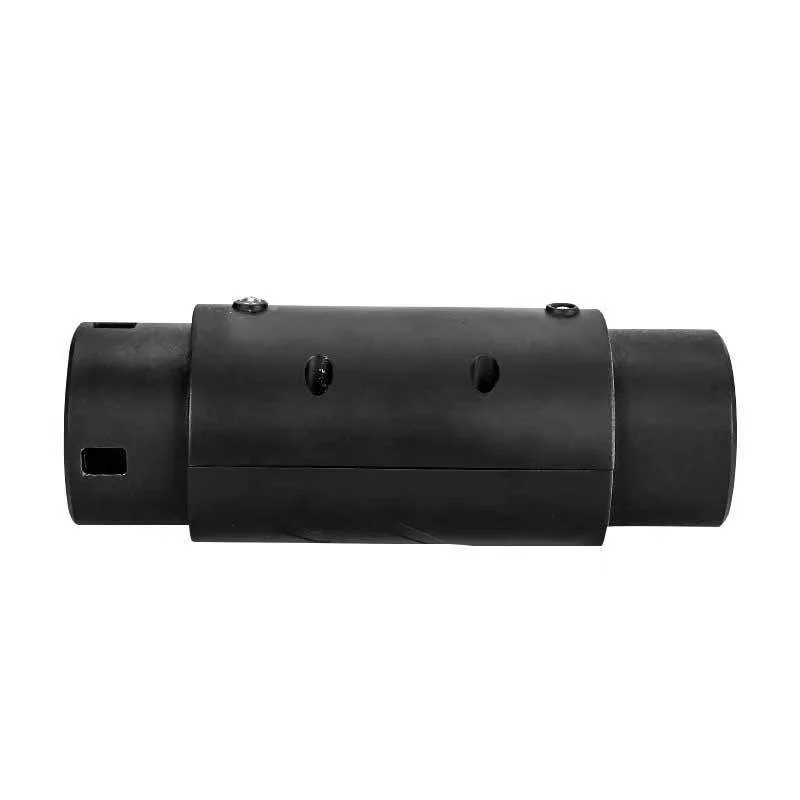
With the surge in China’s electric vehicle exports and the rise of self-driving travel at home and abroad, the compatibility issues between CCS2 (Europe’s mainstream charging interface) and GB/T (China’s national standard) charging pile interface have gradually become prominent. Recently, the high-performance “CCS2 to GBT Adapter” launched by many domestic technology companies has brought a breakthrough in solving this pain point. It is not only a conversion tool for physical interfaces, but also a “communication bridge” for smart charging.
Core functions directly hit user pain points
Cross-border worry-free charging: European CCS2 interface vehicles (such as Tesla, Volkswagen ID series, etc.) can be connected to China’s GB/T charging network without modification, solving the dilemma of “difficulty in finding charging piles” for imported vehicles and outbound car owners.
Plug and play, convenient and efficient: CCS2 to GBT Adapter is equipped with intelligent communication protocol conversion function, automatically identifies charging power, is compatible with DC fast charging piles, and significantly improves the utilization efficiency of public charging facilities.
Safety assurance without compromise: integrated safety modules such as overcurrent protection, overvoltage protection and temperature monitoring, and passed the national mandatory CQC quality certification to ensure reliable operation in high-voltage charging environments.
Product technical advantages are significant
High-quality conductive material: high-strength alloy conductors are used, with low internal resistance, supporting a maximum current of 250A, meeting the 80-150kW fast charging requirements of most models.
Industrial-grade protection design: The shell has an IP54 protection level to cope with complex outdoor environments; equipped with a liquid cooling system to ensure stable operation under high power.
Intelligent control chip: built-in dual-protocol identification chip, which can handle the communication handshake and charging process management of CCS and GB/T, and realize “senseless” switching.
After the adapter was launched, it effectively alleviated the shortage of charging resources for cross-border vehicles. Industry insiders pointed out that the CCS2 to GBT Adapter will significantly improve the international compatibility of China’s charging infrastructure, provide key technical support for the global development of new energy vehicles, and help realize the industry vision of “cars travel thousands of miles, charging without boundaries”.